

Emotional Detachment: The Hidden Success Habit of Billionaires.

A man standing in an open field, gazing at distant mountains, symbolizing emotional detachment and inner peace with nature
lachlan-dempsey-6VPEOdpFNAs-unsplash-1-819x1024 Emotional Detachment: The Hidden Success Habit of Billionaires.

Have you ever felt overwhelmed by emotions—whether your own or someone else’s? If yes, then emotional detachment might be the skill you didn’t know you needed. Far from being “cold” or “unfeeling,” emotional detachment is a psychological strategy that helps you regulate your emotions, create healthy boundaries, and improve your mental clarity. In this guide, you’ll discover why detachment matters, what science says about it, and how you can practice it in your daily life.

What Is Emotional Detachment?

In simple terms, emotional detachment is your ability to step back from overwhelming feelings without shutting them down completely. Think of it like putting on a pair of noise-canceling headphones—you’re still aware of the noise, but it doesn’t control you.

Research in cognitive-behavioral therapy (CBT) suggests that when you detach emotionally, you activate the rational part of your brain (the prefrontal cortex) instead of letting the amygdala (your fear and stress center) run the show. This shift helps you respond thoughtfully instead of reacting impulsively.

Why Emotional Detachment Is Not “Coldness”

You might think detachment means becoming emotionless—but it’s actually the opposite. When you learn to detach, you’re able to experience emotions without being consumed by them. For example:

If a coworker lashes out, detachment helps you avoid absorbing their anger.

If you face rejection, detachment helps you see it as feedback rather than a personal attack.

In fact, psychologists emphasize that healthy detachment = emotional intelligence + self-control. It’s not about ignoring feelings but about managing them better.

The Science Behind Detachment and Stress Reduction

Studies in neuroscience show that rumination—constantly replaying negative events—keeps your brain stuck in stress mode. Detachment interrupts this cycle.

According to a 2019 study published in Frontiers in Psychology, people who practice cognitive reappraisal and detachment report lower anxiety, better resilience, and improved decision-making under pressure.

So, when you practice emotional detachment, you’re literally rewiring your brain to handle stress more efficiently.

Practical Ways You Can Practice Emotional Detachment

Mindful Observation
Instead of identifying with your feelings (“I am anxious”), shift to observation (“I notice anxiety”). This shift is proven in many studies, such as ACT(Acceptance and commitment therapy) for reducing anxiety and stress levels.

Cognitive Reframing
Ask yourself: Is this situation permanent, pervasive, or personal? The most probable answer would be no. Reframing reduces emotional overwhelm.

Boundary Setting
Learn to say “no” without guilt. setting boundaries make the wall between your commitment and your personal space, it protects your energy and balance your emotion.

Breathing and Grounding
Deep breathing activates your parasympathetic nervous system, calming stress responses. Even 3 minutes of controlled breathing can reset your emotional state.

Detach from Overthinking
Journaling or practicing “thought defusion” (visualizing your thoughts floating away like clouds) helps you distance yourself from unhelpful mental loops.

When Emotional Detachment Becomes Unhealthy

There’s a flip side: over-detachment can make you withdrawn, avoidant, or numb. Psychologists call this maladaptive detachment, often linked to trauma or unresolved stress. If you find yourself avoiding intimacy or suppressing all emotions, it may be time to seek therapy to restore balance.

Last writes

If you’ve been struggling with overwhelming feelings, relationships that drain you, or constant mental noise, emotional detachment can be your secret weapon. By applying science-backed techniques, you’re not running away from emotions—you’re mastering them. And once you master them, you’ll find more peace, clarity, and resilience in every aspect of life.

Breathe Better, Live Brighter: Ancient Wisdom & Science Behind Breath.

From the moment we’re born, our breath is our first and most loyal companion. Yet, we rarely pay attention to it—until stress, anxiety, or fatigue force us to. What if you could harness the simple act of breathing to not only calm your mind, but also transform your health, balance your energy, and connect to your higher self?

Welcome to the transformative world of breath meditation, where ancient Ayurvedic traditions meet modern scientific validation. In this guide, we’ll dive into five powerful breathing practices—rooted in Tibetan and Buddhist wisdom, enhanced by yogic science, and confirmed by research—so you can breathe with purpose and live with power.

Why Breath Is Your Body’s Master Key

In Ayurveda, the breath—or prana—is the subtle energy that sustains life. Prana governs not only your physical processes (like oxygenating blood), but also your mental clarity and emotional stability. According to yogic science, when prana flows freely, the body and mind remain in harmony. When blocked, disease, stress, and imbalance take root.

Modern science agrees. Studies show that breath regulation can activate the parasympathetic nervous system, reducing cortisol (the stress hormone), lowering blood pressure, and even improving immune function.

A 2018 study published in Frontiers in Human Neuroscience revealed that just five minutes of deep breathing can reduce heart rate variability and promote emotional regulation. Meanwhile, traditional Ayurvedic texts like the Hatha Yoga Pradipika and Charaka Samhita detail how pranic breathing (Pranayama) strengthens ojas (vitality), tejas (mental clarity), and sattva (spiritual purity).

Let’s now explore five incredible breath-based meditation techniques that unite East and West.

1. Mindfulness of Breath: The Gateway to Presence

Rooted in: Buddhist mindfulness traditions
Scientific name: Focused Attention Meditation (FAM)
Ayurvedic equivalent: Sama Vritti Pranayama (Equal Breathing)

pexels-valeria-ushakova-603898-3094215-683x1024 Breathe Better, Live Brighter: Ancient Wisdom & Science Behind Breath.

The Practice:

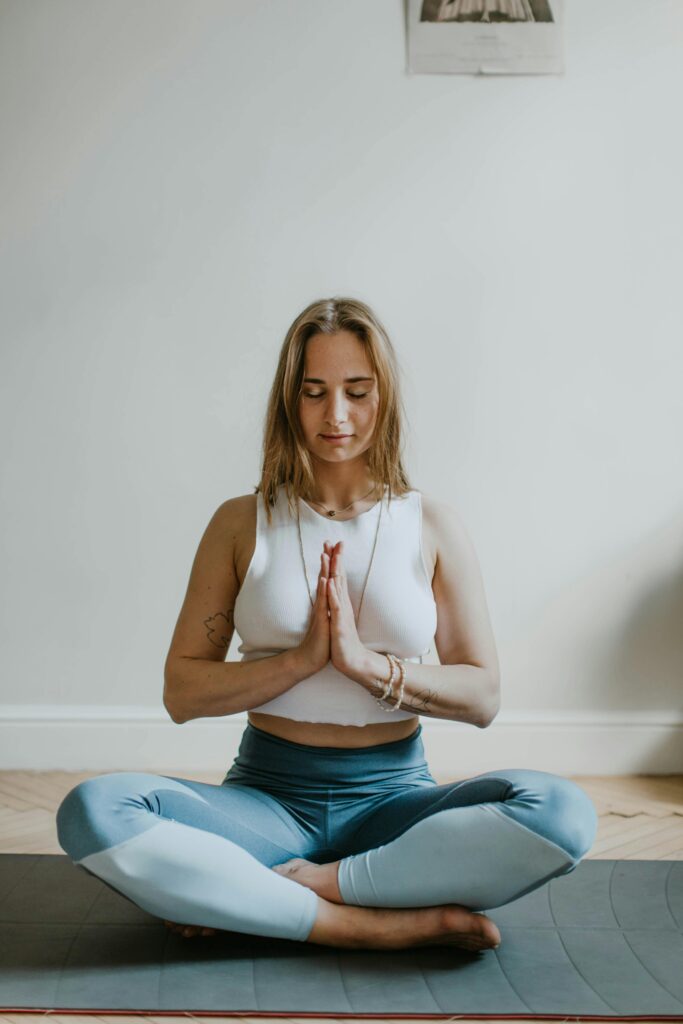
Sit cross-legged or in a chair with your spine straight. Gaze softly downward or close your eyes. Focus solely on the inhale and exhale. Each time your mind wanders (which it will), gently bring it back to the breath without judgment.

The Science:

Mindfulness-based breath awareness activates the prefrontal cortex, the brain’s center for executive function. A study in JAMA Internal Medicine found that participants who practiced breath-based mindfulness for eight weeks reported less anxiety, better sleep, and improved emotional control.

The Ayurvedic Lens:

This practice stabilizes Vata dosha, the energy of movement and communication. When Vata is balanced, you feel grounded, calm, and mentally clear. Use this breath when your mind races or when you’re overstimulated by screens or decisions.

2. Mixing Mind and Space: Dissolving the Ego

Rooted in: Vajrayana Buddhism
Ayurvedic equivalent: Antar Mouna (Inner Silence)
Spiritual aim: Expand consciousness and dissolve identification with the ego

The Practice:

Focus your attention on the out-breath. Visualize your breath merging into space. As your mind softens, release all thoughts. With each exhale, dissolve more deeply into the infinite awareness around and within you.

The Science:

Studies show that breath-focused meditations increase gamma brainwave activity, associated with higher states of consciousness and deep introspection. Research in Cognitive, Affective & Behavioral Neuroscience has shown this practice reduces activity in the default mode network (DMN)—the part of the brain responsible for rumination and self-referencing.

The Ayurvedic Lens:

This practice supports the Sattvic mind, cultivating peace, clarity, and detachment from ego. It also helps reduce excess Pitta, especially when driven by overachieving or perfectionism.

3. Tonglen: Breath as Compassion in Motion

Rooted in: Tibetan Buddhist practice
Meaning: “Giving and Taking”
Ayurvedic equivalent: Bhavana (mental visualization) + Pranayama

The Practice:

With each inhale, visualize yourself absorbing the pain and suffering of others as a dark cloud. On the exhale, send out healing, joy, and compassion as a cool, white mist. Start with someone you love, then include strangers and eventually even those you dislike.

The Science:

Research in Psychological Science supports that compassion-based meditations like Tonglen increase positive affect and empathy. A Stanford study found that just two weeks of compassion meditation boosted emotional resilience and pro-social behavior.

The Ayurvedic Lens:

Tonglen elevates Sattva while purifying emotional toxins (mental ama). It bridges Anahata (heart chakra) and Ajna (third-eye chakra), aligning higher emotional intelligence with spiritual insight.

pexels-ramazphotos-31655736-683x1024 Breathe Better, Live Brighter: Ancient Wisdom & Science Behind Breath.

4. Cleansing Breath: Energize and Detoxify

Rooted in: Tibetan yogic practices
Alternate name: Nine-Cleansing Breaths
Ayurvedic equivalent: Nadi Shodhana (Alternate Nostril Breathing)

The Practice:

  • Close your left nostril with your finger and inhale through the right.
  • Exhale through the left.
  • Repeat three times, then reverse nostrils.
  • Finally, breathe in and out through both nostrils with full exhalation.

The Science:

Alternate nostril breathing balances activity between the left and right hemispheres of the brain. It activates the parasympathetic nervous system, reduces anxiety, and increases oxygenation efficiency.

A study in International Journal of Yoga found this practice reduces blood pressure, increases lung function, and enhances mental performance.

The Ayurvedic Lens:

This breath purifies nadis (energy channels) and balances all three doshas—Vata, Pitta, and Kapha. Do this in the morning or before meditation to energize and detox your system.

5. The 4-7-8 Breath: Restful Sleep, On Demand

Rooted in: Modern integrative medicine
Popularized by: Dr. Andrew Weil
Ayurvedic inspiration: Chandra Bhedana (moon-piercing breath)

The Practice:

  • Inhale through your nose for 4 seconds.
  • Hold your breath for 7 seconds.
  • Exhale audibly through your mouth for 8 seconds.
  • Repeat the cycle 4 times (or more).

The Science:

This technique rapidly lowers heart rate, calms the nervous system, and facilitates sleep by stimulating the vagus nerve. It’s shown to reduce sympathetic overdrive, which is linked to insomnia, panic attacks, and hypertension.

The Ayurvedic Lens:

Aligns with cooling, lunar energy, calming the mind and body before sleep. Especially helpful for Pitta-related imbalances like irritation, anger, or restlessness.

pexels-ivan-samkov-6648560-1024x683 Breathe Better, Live Brighter: Ancient Wisdom & Science Behind Breath.

How to Incorporate Breath Meditation Into Daily Life

  1. Morning Clarity: Start your day with Cleansing Breath to clear mental fog and awaken the senses.
  2. Midday Reset: Practice Mindfulness of Breath to refocus during work or study.
  3. Emotional First Aid: Turn to Tonglen when feeling overwhelmed or disconnected.
  4. Evening Wind-Down: Use 4-7-8 Breath to release tension and prepare for sleep.
  5. Weekly Deep Dive: Dedicate 20–30 minutes to Mixing Mind and Space for spiritual insight and ego release.

Breathe With Intention, Heal With Wisdom

Breath isn’t just air—it’s awareness, energy, and medicine. It’s the bridge between your mind and body, and the gateway to your higher self. Whether you follow Ayurveda, Buddhism, or neuroscience, the message is clear: control your breath, and you can transform your life.

So, as you sit with your next breath, remember—it’s not just about surviving. It’s about thriving, awakening, and evolving.

Ready to begin? Just inhale… exhale… and trust in the power of your breath.

Raising Rage: How the Internet Is Teaching Boys to Hate.

There was a quote running around the internet
“men have fear of people laughing at them , women have fear of getting killed.”

This is true when Netflix ‘s new age show ‘Adolescence kicks in .

It’s about 13 year old boy who killed his classmate cold blooded. The theme is dark, intriguing and disturbing – but it’s authentic

To be honest , that wasn’t just the series – It’s happening all around the globe.

Why are boy hating the things so much ?

the boy in the movie doesn’t move the rock in one day, Ever heard of the digitized culprit – he got influenced by internet.

Yes, social media like Youtube, Instagram, Podcasts.

Wait , strange right?

There is more weirder word prevails Manosphere

This means the spaces influenced by so called “Alpha male” who claims they are helping the male in society to become better at the cost of hate against women.

There are various internet personalities popping out of internet  , having  millions of followers , they talks about money, fitness,  manlihood

But beneath all that there is perception that

Womens are weak creatures

They are controlling mens life by hacking their psychology and emotion

As a man they must dominate in sphere

But sadly  many young lads thinks it’s true they belives them.

It’s not only the west , It’s happening in the Eastern counterpart too.

People in the East have their own internet superhero. They too talk about

Gym , money , girls and as above their face becomes red

When they utter

 Don’t believe in women

Don’t marry and stay out of alimony trap

Feminism must be crushed , they are creating toxicity in families.

These hateful comments are spreading lilke fire and many young boys have come under it.

Don’t you think it’s dangerous , a boy watches it’s a internet influencer video and have a  built a wrong perception about the women , he got deep rooted in his mind that women’s are the problem , and in case of adolescence their energy and emotion do turns into dark action of violence.

So it’s well stated in above that boys are getting red too much and girls are wiping out .

And why not we can see in real life also , If a woman wants a divorce , people have their own script like she is greedy and corrupt or if a mans takes his own life , everyone one impulsly blames their wifes and girlfriends .Whole society blames woman , but the thing is when woman get hurts or killed no body get in the circle of suspicion.

This is Real and horribly it’s expanding

Let me give you the truthbomb , these internet personality aren’t remained entertainers now they are manipulating the young minds to the terrible things,

The boys are listening to these mens saying ,

About contolling women ,

Beating them or blaming them if life ask the tough questions.

The little minds does find the easy way to solve it and they believe the opinions of these influencer.But most downheartedly they act on it without having an second thought.

With this all being said How we can save our young girls and boys from dying and maniputated.

It’s useless to say that boys will grow out of it , when they’ll have responsibility on their shoulder.No it’s not unless we help them out.We need to talk to the boys , impart the lessons that strength doesn’t means lifting heavy weights or knocking other persons out it means kindness and respects.We understand their physical characteristic but boys must learn not to driven away by their emotion ,they must learn to grow compassionately with girls and yes they girls are their enemy.

On the end point note

I think that the world is asking the wrong question about how to raise the boys better,we need to change this and ask what kind of boys we are raising?

Do we need the men who is full of anger and anxiety or men with compassionate heart and respect? We need to act now so in coming future we can probably save girls from wiping out .